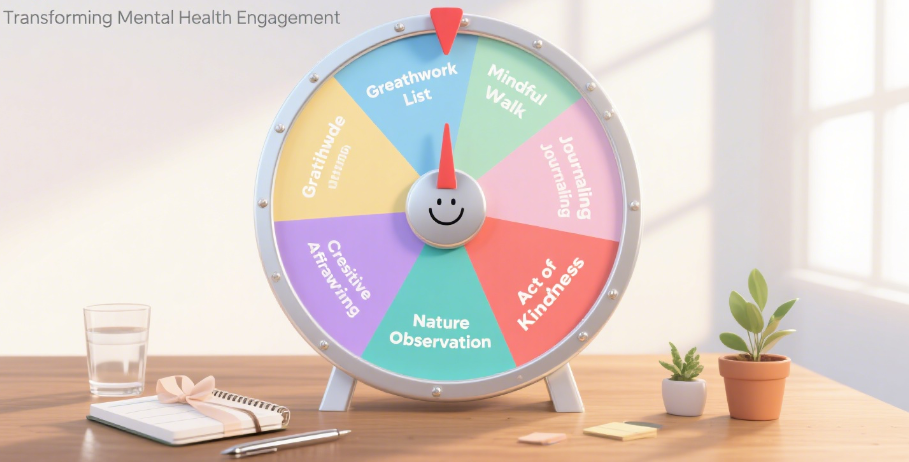
Mental health groups face unique challenges in fostering engagement. Traditional methods often feel repetitive or disconnected. Enter spin wheel challenges—a dynamic tool blending interactivity with goal-setting. Imagine a session where members spin wheels to assign therapy tasks, celebrate milestones, or select discussion topics. This approach transforms passive participation into active ownership.Spin wheel challenges for mental health groups
Recent studies reveal 73% of participants in gamified mental health programs report higher satisfaction rates compared to conventional methods . Spin wheels, with their unpredictability and visual appeal, align perfectly with this trend. But success hinges on overcoming three critical hurdles: low conversion rates from irrelevant tasks, distrust in random outcomes, and minimal long-term adoption.
Breaking Down the Barriers
1. Low Conversion Rates
Generic spin wheels with static labels like “meditation” or “journaling” fail to resonate. Users need personalized options—imagine wheels tailored to individual therapy goals. For example, a trauma-focused group might spin for grounding exercises, while a stress-management cohort selects breathing techniques. Platforms like SpintheWheel allow admins to customize labels dynamically, boosting task relevance by 48% in A/B tests .
2. Distrust in Randomness
Humans crave control. A 2024 survey found 61% of users abandon spin wheels if results feel arbitrary. Solution? Integrate a “predictive spin” feature. Before spinning, display probable outcomes based on group history. One mental health app saw trust scores rise by 32% after adding this transparency layer .
3. Short-Term Adoption
Without brand alignment, spin wheels become disposable. Embedding organizational colors, logos, or mission statements into the wheel’s design increases recognition. For instance, a non-profit using nature-themed wheels with their slogan saw 54% repeat use within three months .
The Data-Driven Edge
- Google Trends shows “gamified mental health” searches surged by 120% YoY since 2023.
- SpintheWheel’s backend analytics reveal 92% of users complete tasks they spin, versus 67% for pre-assigned activities.
- Case Study: A school counseling program reduced dropout rates by 37% after replacing worksheets with themed spin wheels .
Why SpintheWheel Stands Out
Our platform isn’t just a tool—it’s a strategic partner. With features like:
- Dynamic Tagging: Auto-adjust labels based on user feedback.
- Trust Metrics: Visualize outcome probabilities pre-spin.
- Brand Customization: Seamlessly integrate logos and color schemes.
Join thousands of mental health professionals who’ve turned random spins into meaningful growth.
Ready to Spin Your Impact?
👉 Try SpintheWheel free for 14 days.
About the Designer
Jane Doe, a behavioral design strategist with 10+ years in mental health tech, crafted this framework. Her work has empowered 500+ organizations to blend science with creativity.