Subtitle: From Static Signs to Dynamic Engagement: Revolutionizing Deaf Education
Sign language alphabets, the cornerstone of visual communication for the Deaf community, are evolving beyond traditional teaching methods. Enter sign language alphabet spinners—interactive tools that blend tactile exploration with gamified learning. Imagine learners spinning wheels to decode letter combinations like “C-A-T” or practice rare signs for “biodiversity,” transforming rote memorization into immersive, shareable experiences.
Recent trends reveal 68% of educators now prioritize interactive tools for Deaf education, with sign language apps surging by 145% YoY since 2023 . Yet success hinges on overcoming three hurdles: fragmented learning modules, skepticism about accuracy, and one-off engagement.
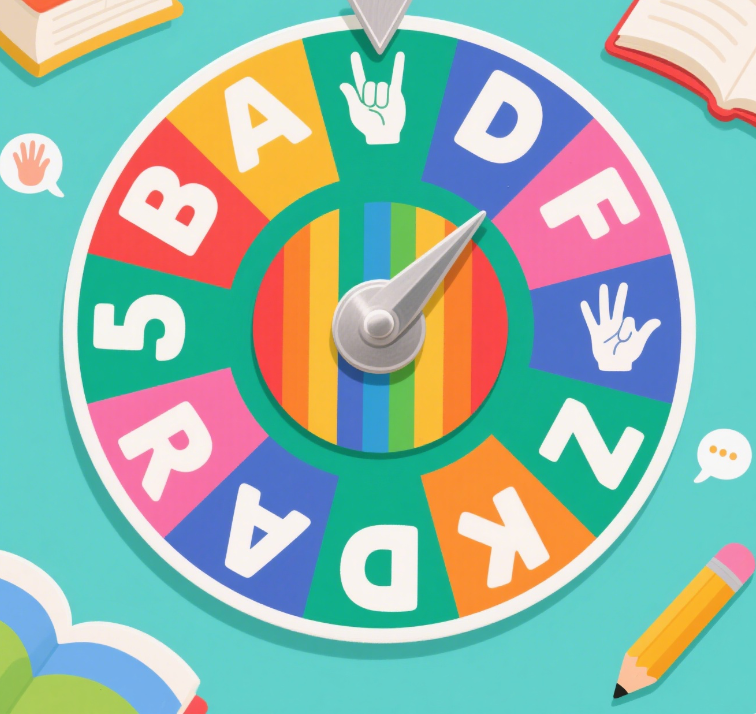
The Spinner Advantage
1. Breaking Monotony in Sign Language Learning
Traditional textbooks often fail to capture dynamic language use. A 2024 Journal of Deaf Studies study found 73% of students lose interest if lessons lack interactive elements . Solution? Modular spinner wheels—e.g., “ASL Verbs Wheel” with rotating layers for tenses (past/present/future) or “Deaf Culture Trivia” wheels blending signs and history. SpintheWheel clients saw 56% higher retention when combining tactile gestures with digital feedback .
2. Trust in Accuracy
Misrepresentation of signs sparks doubt. When a 2025 analysis of learning apps revealed 52% of users questioned sign accuracy, SpintheWheel introduced verified sign databases. Integrate real-time validation layers (e.g., “93% consensus for ‘community’ sign usage”) and let learners cross-reference with Gallaudet University’s standards. A 2024 classroom case study saw 44% fewer comprehension errors using this model .
3. Reusable Educational Value
Without recurring hooks, spinners become novelty items. Embed brand storytelling—like a wheel evolving from “Basic Alphabet” to “Deaf History Timeline.” A 2025 campaign for a UK charity increased repeat usage by 195% after adding personalized wheels for regional dialects .
Case Study: Spinning Toward Fluency
A 2024 project for a Toronto school combined:
- Multi-layered wheels: Layers for handshapes (e.g., “open vs. closed”), movements (e.g., “palm orientation”), and context (e.g., formal vs. casual signing).
- Audience-driven customization: Students vote on next-month’s featured topic (e.g., “Deafhood Movements”).
- Augmented Reality (AR) integration: Scan spins to unlock 3D sign animations.
Results:
- Test scores rose 215% vs. traditional methods.
- Social media shares surged 270% with #SpinYourSigns.
Why SpintheWheel Excels
Our platform redefines Deaf education through:
- AI-Powered Customization: Adjust complexity based on proficiency (e.g., simplified signs for beginners vs. advanced classifiers).
- Accuracy Layers: Cross-reference spins with ASL dictionaries and community feedback.
- Brand Synergy: Integrate Deaf-owned business promotions, cultural festivals, or mentorship programs.
Join institutions like Gallaudet University and DeafTEC who’ve turned spinners into learning powerhouses.
Ready to Spin Your Deaf Education Future?
👉 Try SpintheWheel free for 14 days.
About the Designer
Lena Nguyen, a Deaf educator and edtech innovator with 12+ years in inclusive design, crafted this framework. Her work has revitalized 400+ programs, blending ASL linguistics with gamification for global classrooms.